
From the Deep Archives: 1976 interview with Arthur Bell

I haven’t thought about Arthur Bell in a long time, but his name has resurfaced with the festival showings of Jeffrey Schwartz’s documentary film Mineshaft: The Cruising Murders. The documentary focuses on both the murders of gay men that inspired the William Friedkin movie Cruising (based on the Gerald Walker* novel) and the community protests that erupted on the streets of the West Village during the making of the film in 1979.
According to the press kit for the documentary, “When the shooting script was leaked to Village Voice reporter Arthur Bell, he was horrified, fearing the film would portray gay men as dangerous and pathological, as well as fuel discrimination at a time when the community was fighting for visibility and dignity. Bell encouraged his readers to protest the film, and thousands heeded his call. Protestors swarmed the streets, disrupting production and demanding Hollywood stop exploiting queer lives for sensationalism.”
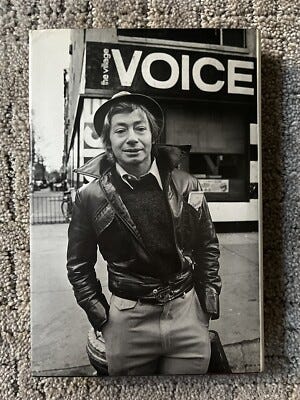
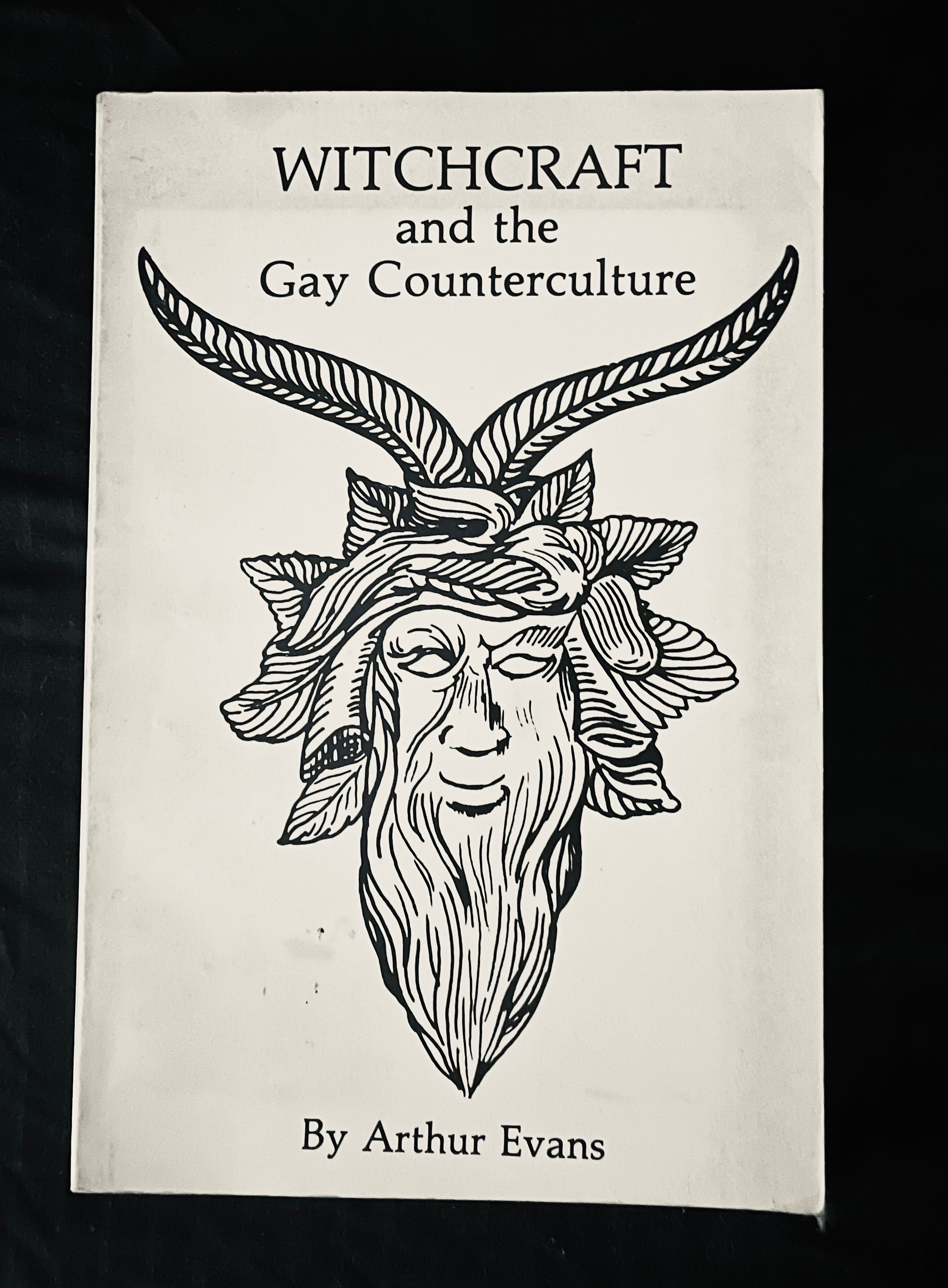
Probably not many people alive today know who Arthur Bell was, but at the time he was possibly the most prominent openly gay journalist in the country. He was an inspiration to me as a 22-year-old budding gay journalist right out of college reading his columns in the Village Voice. I interviewed him in 1976 for Boston’s Gay Community News, and we hung out a few times when I would visit New York. He let me stay at his place a couple of times. (I only had to have sex with him once.) He may have introduced me to Vito Russo (who became a friend and neighbor), Bob Weiner (gossip columnist for the Soho Weekly News), and other emerging gay writers. I think he took me to see Jeff Wanshel’s Off-Broadway play Isadora Duncan Sleeps with the Russian Navy, starring Marian Seldes. He was kind and welcoming to a fresh-faced kid. When I moved to New York in 1980 and started writing for the Village Voice, I think he felt threatened by me and ceased being friendly. But I always treasured getting to know him as a link to the previous generation of gay liberation writers and activists. (He was partnered for a time with Arthur Evans, who has a place in gay literary history as the author of the pioneering Witchcraft and the Gay Counterculture, first published in 1978.)
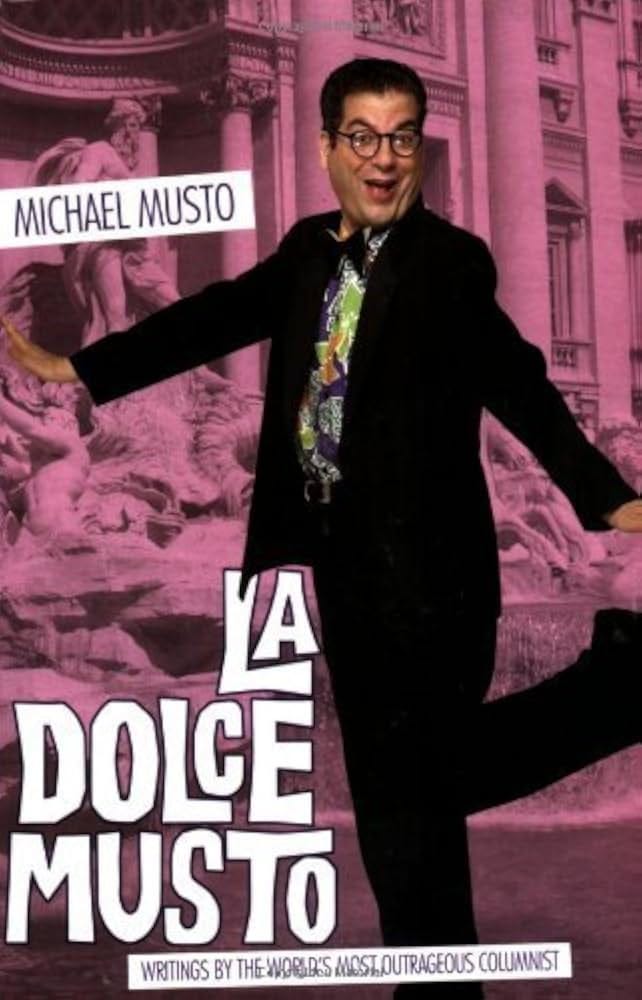
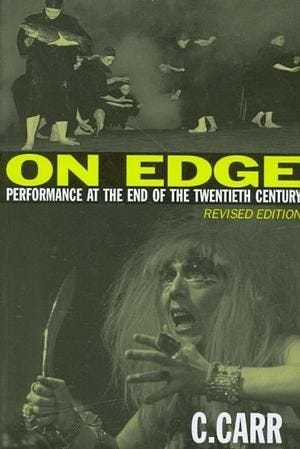
After Bell died in 1984 (supposedly from complications from diabetes but it could also have been AIDS-related), the Village Voice went looking for someone to take his place as the newspaper’s gay columnist. The choice came down to me and Michael Musto. Kit Rachlis, who was then the editor-in-chief and an old friend of mine, had to break the news to me that I would not be getting the job. It’s just as well – my column would have been more intellectual and downtown-performance-oriented, whereas “La Dolce Musto” took the town by storm and made a star out of Musto. I didn’t hold it against him (we’d been colleagues at Soho News, and I could never do what he did), and C. Carr eventually started writing an excellent downtown-performance column for the paper called “On Edge.”
It’s fascinating to look back at my interview with Arthur Bell, to see all the names and issues that were current then but are Wikipedia footnotes now. I’d forgotten that there was once a newspaper in New York City called Gay Power! Although every month is Pride Month as far as I’m concerned, I’m offering up this piece of vintage gay journalism as a token Pride special.
* ARTHUR BELL
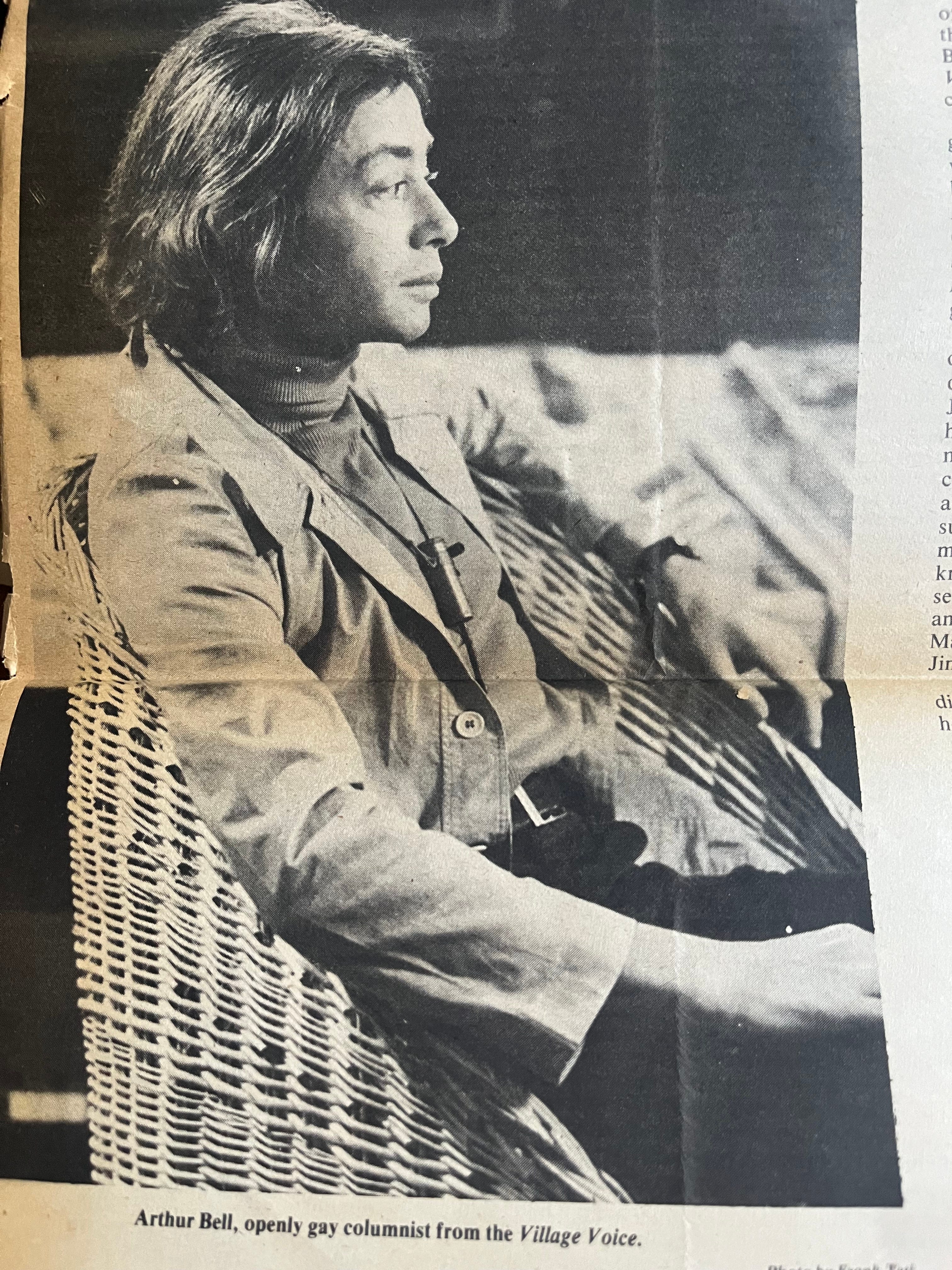
Film critic Andrew Sarris once called him “the Voice’s own version of Rona Barrett.” Another well-known New York media person grumbled, “He’s made a lot of enemies in this city because he’s so indiscreet.” Although he actually considers himself a New York diarist and the soul of discretion, Arthur Bell doesn’t mind comments like those above, because he enjoys being a controversial writer. Besides which, thanks to his weekly “Bell Tells” in the Village Voice, he is the most widely-read openly gay columnist in the country.
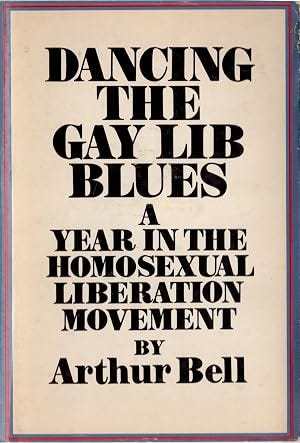
Bell’s writing career happened as a direct result of the gay activist movement spawned by the 1960s. While working at Random House as publicist for children’s books, he joined the movement as a co-founder of the Gay Activists Alliance (GAA). His news articles for Gay Power, Gay, and the Voice earned him a contract to write Dancing the Gay Lib Blues: A Year in the Homosexual Liberation Movement, an irreverent, ground-level view of the birth of gay activism, published by Simon & Schuster in 1971.
Five years later, now a well-known freelance writer of movie star interviews and crime stories, he is working on a book about the murder of Philadelphia newspaper heir John Knight III. But, like many of the original activists, he has almost totally dissociated himself from “the movement” such as it is today, although he continues to be consulted as a gay spokesperson.
When I visited Arthur Bell at his Upper East Side apartment one rainy afternoon this summer, he was asked via a phone call from Blueboy magazine to comment on the new gay movement. “I don’t know,” he sighed, “is there a new gay movement? When I see any of the old movement people, which is rarely anymore, we don’t talk about the gay movement or zapping Mayor Lindsay…What do we talk about? Our love lives, Jimmy Carter….”
During the “informal non-interview” that follows, we discussed the gay movement, Ann-Margret, Village Voice homophobia, and gay murders, among other things.
DS: How did you start writing for the Voice?
AB: When GAA was founded, they needed somebody to grind out publicity releases, “What is GAA?” And essentially that’s one of the things I was doing for Random House. That’s how I started writing, and I did it for Gay Power, which was wonderful because in those days we were very fervent, it was a very exciting time. Gay Power and Gay started about the same time – Gay Power was more of a radical paper. In July, 1970, they were bought by a porno king, so the tenor of the newspaper changed. So I took Mary Nichols [then a Voice editor], whom I knew vaguely from my Random House experience, to lunch, and I said, “Hey kid, I’ve got news for you, this is what I’m involved in. Are you interested in stories about gay liberation from time to time?” She said, “If they’re well-written and have something to say, yeah.” So about two or three weeks later there was a sit-in at Rockefeller headquarters followed by a demonstration downtown. When we came back I banged out an article in about an hour. And the next week, lo and behold, it was front-page news in the Voice. The second thing that I did was a scandalous thing on Randy Agnew which sort of established me. (laughs) As a result of that, I got the contract to do the book on GAA, and I left my publicity job, and I did two or three pieces for the Voice while I was writing the book. After that I started writing for the Voice on a regular basis. I’ve always been interested in movies, so I started doing movie people. I was really most interested in writing about gay lifestyles. I did a piece very early on street hustlers, and then I did a piece on street transvestites, and I enjoyed doing things like that. I became a controversial writer pretty early, because I’ve never done propaganda pieces. I’ve always shown the moles as well as the hairspray.
DS: When did you start writing the column?
AB: Oh, I’ve only had the column for about a year and a half. That was because of Ann-Margret actually. I was asked to do an Ann-Margret piece for the Voice prior to the opening of Tommy, and I don’t do interviews with people around – it gets the stars nervous, it inhibits me. Little did I know that Ann-Margret was never let out without Allan Carr, her public relations guy, and Roger Smith, her husband. But they were desperate to get a piece in the Voice, so they agreed. Well, I did this piece with her, and I thought it was somewhat sympathetic, but she really is the dumbest person I’ve ever met in my life. She’s very sweet, you know, she’s a wreck, she cries and cries and cries, and, like, she couldn’t get room service, and tears started crawling, dripping from her eyes. I asked her what her favorite foods in the whole world were, and there were these long pauses, and she’d say, “Wedding cake….” You can understand why they don’t let her out. Then two or three weeks later, I was at the opening of Bette Midler’s show, and that awful Allan Carr, her personal manager, pulls me over – I’m with friends – and what he did essentially was tell me he’d put a contract out on my life. I was very, very nervous, and I went to the office the next day, and I said, “I’m really working without any protection at all,” you know, I really laid it on with a trowel! So they gave me the column! But it was really – I’m not patting myself on the shoulder, but it was the first of this whole revival of, you know, Liz Smith and Bobby Weiner. They’ve all started because of what I was doing, but I wasn’t doing a gossip column, I was doing a sort of New York diary, “Oh, we went here and we fell into the pool and then everybody got drunk,” but I was not taking telephone calls. I didn’t care what Elizabeth Taylor was doing with Richard Burton in Africa. I was just doing what I had seen. I would do a party one week, an interview the next, and they loved it at the paper. But it was all from my point of view, that of an openly gay, crazy person.
I do poke around sometimes – like they had that party for Robin and Marian a little while ago, and there were lots of stars there, so I went over and talked to William Holden and did the Earl Wilson number, but, you see, I come from a different direction, and I think that’s the difference between the type of stuff I do and the type of stuff practically everybody else in this city who has a column does. I’m not interested in if somebody is fucking with somebody else – well, I’m interested, but I don’t use that as a tsk-tsk thing. Y’know? I’m really more interested in fucking people over if they’re hypocrites. The hypocrisy thing is, you know, if there are any leitmotifs in my column-writing, that’s probably what it is.
DS: How do you feel being the Rona Barrett of the Village Voice?
AB: Oh, come on, I don’t even want to waste your tape on that, OK?
DS: Do you feel any responsibility being the most widely-read gay columnist in the country?
AB: When you say that, I feel that I should, but the problem is that I don’t feel any responsibility. I think if I started to, my work would be very weighty. I’m sorry, I wish that I could have more programmed integrity.
DS: Well, I remember one time you mentioned the renovated Club Baths and just folded that in with the rest of your stuff….
AB: Oh, well, I do that, and they love it! The straights out there adore it, just love it! I certainly don’t do it for the straights, I just do it. I find that if it’s boring to me, it goes into the garbage can. But if it reads with zing, it goes through the paper.
DS: Are there things that go on in gay circles that you choose to cover or choose not to cover?
AB: There’s a lot of stuff I choose not to cover. I won’t write gay liberation news, per se, anymore because 1) I’m not involved in it and 2) I don’t think I could do it fairly. I suggest to them occasionally people that should write the story if something comes up, and they do it much, much better than me. Quite frankly, I don’t find it exciting anymore. I’m constantly being lectured to – not constantly, but occasionally I’m lectured to by people who say there are things happening in Queens, and I get bulletins from the church, and I’ve never written about the church, I’ve never written about psychiatry. I’m not interested in that stuff. But I’m an openly gay person, and I have no qualms about it. If something gets me mad, I’ll yell – I have been known to yell in screening rooms at movies. But it’s a personal thing with me, as opposed to an organizational thing. By the same token, if things delight me, I’ll write about it and tell about it. I’ve got the biggest mouth in town.
DS: The Voice has been called homophobic – what do you think about that?
AB: Oh, I think that’s a crock of shit. I think some of the writers that have written for the paper are homophobic, still are, and some of them aren’t. There’s a lot less of it now that Tom Morgan is editor there – he’s more aware of the sensitivity of it. But it wouldn’t surprise me, after having said that, that next week we come out with a big story about why homosexuals are a bore. I don’t know, if the story’s well-written and if it’s somewhat controversial and has some kind of theme and says something that has not been said before in a refreshing way, they’ll use it.
DS: So any homophobia you would attribute to the writers?
AB: Yeah, and also occasionally to the carelessness of an editor. But if a piece is generally homophobic, as was that terrible thing about fag hag movie stars, you really can’t blame the editors. That was a very well-written piece, but that was a homophobic piece and it was written by a man who is gay, which makes it even worse. People tend to forget that for every homophobic story that gets published in the Voice, we have 15 that aren’t. They also forget that the Voice since the beginning has been doing more homosexual reporting than perhaps any other paper in the country. There is not an editorial policy that says, “We are going to publish anti-homosexual pieces.” In fact, four or five months ago, some coalition got together, and they came over to the Voice, and I cannot tell you how many people showed up. It was supposed to be an exchange of ideas, and everyone from Tom Morgan to the lowliest shipping clerk showed up for that meeting. And it was interesting; they told us what the gripes were, and it was an interesting, honest exchange. I don’t know if that ever happened at the Times or the Post. Which doesn’t make us any better, but we’re aware of the problems. Morgan’s been in since September – he’s great, a very, very honorable, decent man (laughs) I am not paid by the Voice in any public relations capacity….
DS: What else do you write for besides the Voice?
AB: Well, since I got the book contract I’ve stopped writing for everybody, but I write for Esquire and Cosmo and Viva. Different things – I do interviews for Viva, and I did a thing on tap dancing for Cosmo, and one on movie magazines. For Esquire, I’ve done three pieces which are the best magazine pieces I’ve done. The hairiest thing I’ve ever done was that thing on the Houston murders. I got down there two days after it happened, I was there when they were digging up the bodies – the deal with Esquire was, they figured the Times would be doing a psychological study of the brain cells of Dean Corll and the news stories would all be covered, so they thought it would be interesting to talk to the families, so that’s what I did when I got down there. They poured their hearts out. I’m usually able to keep a little window between what I’m doing and who I am, but I couldn’t with these people. I got sick down there – when I got back here it took me six weeks before I could sit down at the typewriter to write about it. Right after it happened, they had a big town meeting at this church, and all the politicians were saying, “Vote for me, and I’ll see that this never happens again,” and the church people were saying, “Put a pool table in the church, and the kids won’t hang around on the street,” and all that had nothing to do with what happened.
![Kings Don't Mean a Thing: The John Knight Murder Case [Book]](https://substackcdn.com/image/fetch/$s_!ql4u!,f_auto,q_auto:good,fl_progressive:steep/https%3A%2F%2Fsubstack-post-media.s3.amazonaws.com%2Fpublic%2Fimages%2Ff253c201-507f-44d0-bbb6-49dcfbec7ecd_375x500.jpeg "Kings Don't Mean a Thing: The John Knight Murder Case [Book]")
DS: You’ve said that you like covering crime stories better than anything else. Why is that?
AB: Because there’s always a scent of mystery. If you’re covering a movie star, you know all about them before you go in, so you’re trying to pull stuff from them that’s new and interesting. But you hit a new town, and somebody’s just been murdered, and you’re with a whole new flock of people, and what you’re doing is putting together a crossword puzzle. You’re really the star when you’re covering a murder. Your perception of it and the way you handle it is a whole different thing. It’s a problem at this point because there’s so much, there are so many different angles to the Knight murder – the political thing, the whole thing about the newspaper chain and the grandfather. As I got to learn more about the people involved it turns out that I do like everybody – the murderers and the murdered.
For instance, when I was down there covering the Soli trial, you know – okay, so he’s a real first class sonofabitch, he’s been involved in crime since he was a teenager, he’s 37 now, and all the terrible things with pushing pills to kids, but there he is in court and his mother, who was very sick and had to be wheeled in every day, would not stay at home, she wouldn’t miss a moment of it. And when the district attorney comes out and gives this absolutely elegant speech about how he believes that Soli executed the actual murder of John Knight, the mother has a heart attack in court. And Soli, whose mouth had been shut up to that point, starts calling the district attorney a motherfucker and sonofabitch and all that. You’re dealing with raw emotion there, and you’re also realizing that this man may be the most horrendous person on earth, but there’s the whole family thing there, it’s a whole different side of his personality. I love doing stuff like that.
DS: Do you have any sights or goals beyond the book you’re doing?
AB: Oh, Don, I’ve got no sights and no goals. Maybe more books. I don’t know, really. The thing for me to do is to get this done and do it brilliantly.
DS: Is there anything else you might want to say to the readers of GCN?
AB: No. I don’t know, “Keep slugging, kids?”
Published in Gay Community News, October 2, 1976
* I met Gerald Walker at a holiday cocktail party at our mutual friend Ken Emerson’s apartment soon after I moved to New York in 1980. I got into a conversation with him about Cruising that became so heated that Ken had to intercede. Ken had been a friend and colleague at the Boston Phoenix and moved to New York to become editor-in-chief of the New York Times Magazine. Gerry Walker was an assigning editor at the magazine and a few years later would assign and edit my profiles of Laurie Anderson, Arthur Kopit, and David Geffen. He was married at the time to Joanna Simon, sister of Carly, who after Gerry died became companion and caretaker of legendary TV newscaster Walter Cronkite in his final years. And today my husband is an editor at the New York Times Magazine. Teeny-tiny world….
If you are enjoying these posts, please consider becoming a subscriber. All eyes are welcome, and I especially appreciate paid subscriptions. They don’t cost much — $5/month, $50/year — but they encourage me to continue sharing words and images that are meaningful to me. If it helps, think of a paid subscription as a tip jar: not mandatory but a show of appreciation.
I’ll never be able to look at Ann Margret again without thinking, “Wedding cake!” Carnal knowledge indeed…Why did Spy have a bug up its ass about Ken?
Yes, I remember the name Don right away on the page and your interview brought Arthur to life Don. You have had quite the life Don.