
Reading List: TERRY DACTYL

I’ve become slightly obsessed with Mattilda Bernstein Sycamore. I’ve read 3 of her 13 books now. After hearing her name bandied about in various literary and social circles for years, I started with The Freezer Door after clocking a rave review in the New York Times Book Review in 2020, then went back to Sketchtasy (published in 2018), and now Terry Dactyl. The Freezer Door was reviewed as a non-fiction memoir, and the other two are ostensibly novels. And yet the voice is consistent enough throughout MBS’s prose that it’s understandable to receive the novels as auto-fiction, thinly disguised self-portraits characterized by long breathless rushes of thought, intimate knowledge of a subculture of young gender-fluid queers maniacally focused on drugs and outfits, and intimations of extreme chemical sensitivity and dietary restrictions, not to mention the use of “the universal she” for all persons of whatever gender.
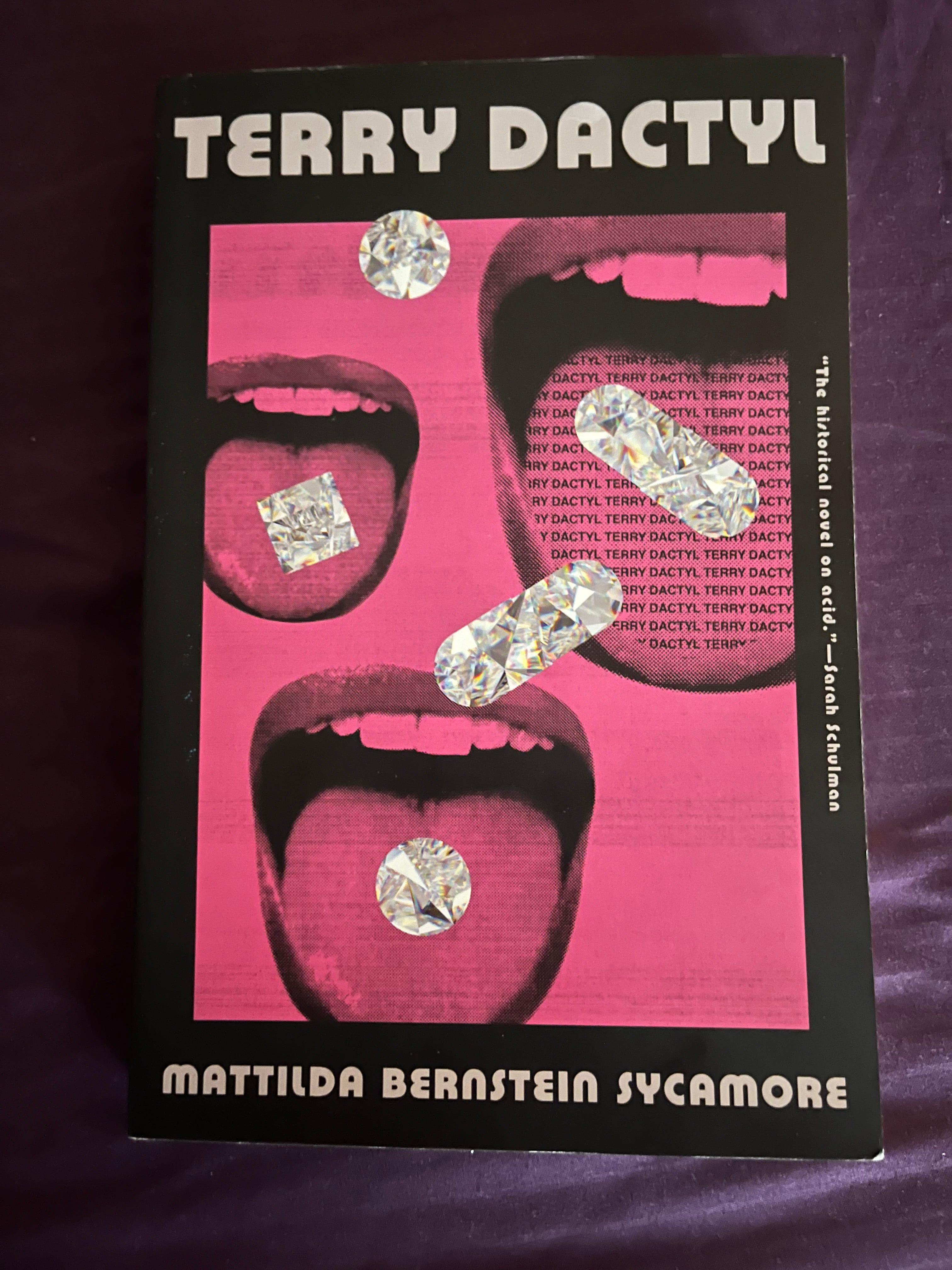
While Sketchtasy takes place in Boston and The Freezer Door in Seattle, Terry Dactyl spends a lot of time in New York City. In the mid-1990s, when people were still dying of AIDS in droves, the title character is a Columbia University dropout who falls in with a gang of drug-addled club kids and finds herself working as greeter at a hip art gallery in Soho owned by a chic legend named Sabine Roth with clear crisp rules for running the business.
Other than those rules, I could do anything. She hired me because of the way I looked, right? I was floating in the sky on two hits of ecstasy and who knows how much K, not to mention a few bumps of coke and the pot I smoked outside Twilo, and then I walked into the gallery in a magenta ’80s prom dress that I’d found at Goodwill, with wings coated in glitter and made of trash, and that giant pink wig that was a bouffant at the top and a mullet at the bottom, with the longest silver and gold eyelashes curling both up and down. And Sabine was enthralled.
And then, once I started working at the gallery, she loved it when my friends would show up. They would show up to pick up a bag of coke and head right to the bathroom. So I had two jobs at once. And Sabine loved it. I don’t know if she knew about the second job, but she definitely loved every single mess that came in to pick up their nose candy, now that I had regular day hours.
Terry’s colorful back story quickly emerges. She was raised in Seattle with lesbian moms whose friend circle comprised numerous delightfully crazy artistic queens whose bohemian lives and tragic AIDS deaths formed the landscape of Terry’s wild childhood, which taught her many lessons useful for being around sick and freaky people in later life.
Dementia means they lead and you follow. Don’t try to bring them back to reality. It’s too late for reality. Reality just means death, and no one wants to think about that, not when they have dementia.
MBS’s dazzling prose skillfully blurs time and gender and the lines between work and art and clubs and drugs and love and sex, all of which comes crashing to a halt when the pandemic hits. The gallery goes on hiatus. Terry’s nervous system goes on overdrive, and she abandons NYC to drive back to Seattle to reckon with the changed world, with the emotional support of her now-sober mothers and the financial support of a former club-kid friend who now works for The Evil Empire (based in Seattle…hmm, which evil empire could that be?). The novel does have an intricate plot, delivered with no linearity but with astonishing freedom to experiment with language, narrative, and sentence structure.
Of course I’ve gone to chiropractic acupuncture massage biofeedback meditation yoga Qigong craniosacral acupressure reflexology kinesiology herbal medicine homeopathy naturopathic medicine integrative medicine and whatever else and yes I take digestive enzymes nettles ginseng peony B12 folic acid multivitamins glutamine amino acids quercetin isoquercitrin rutin goldenseal lobelia mushroom tincture artichoke leaf peptides CBD oil licorice root echinacea probiotics magnesium vitamin C calcium NAC iron omega-3 fatty acids 5HTP d-ribose electrolytes trace minerals colloidal silver zinc garlic drops and who knows what else and yes if I stop the supplements then everything gets worse but that doesn’t mean I’m getting better, and whenever I heard someone in their forties saying they feel like they’re middle-aged I think there’s no way I’m calling myself middle-aged until I feel good for at least a year and at this point I rarely even feel good for an hour so it looks like I’m staying young forever.
One especially crucial sequence of events, leading up to the exodus, is delivered in numbered sentences, like an outline waiting to be filled in. Another long section is driven by the prompt “Things that make me feel less lonely tonight.” There are recipes. There are hardcore West Coast-style political diatribes. “What is mourning, and what is rage? What is silence, and what is a cage?” And you’re never far from laughing out loud.
And it was the best idea ever, standing on that bridge and the way it shook with the cars, all that pink in the sky and the water, the way the sky was the water yes we were on X we were in the sky and when we kissed everything was pulsing, I could feel that current going from lips into mouth down throat and into my pelvic floor, yes, there it was, the pelvic floor, just like my mothers taught me, I remember thinking about the wind on my legs, the wind blowing our hair all over the place, or my hair because she had a shaved head, and then we were holding hands in that way that means forever so of course you know I never saw her again.
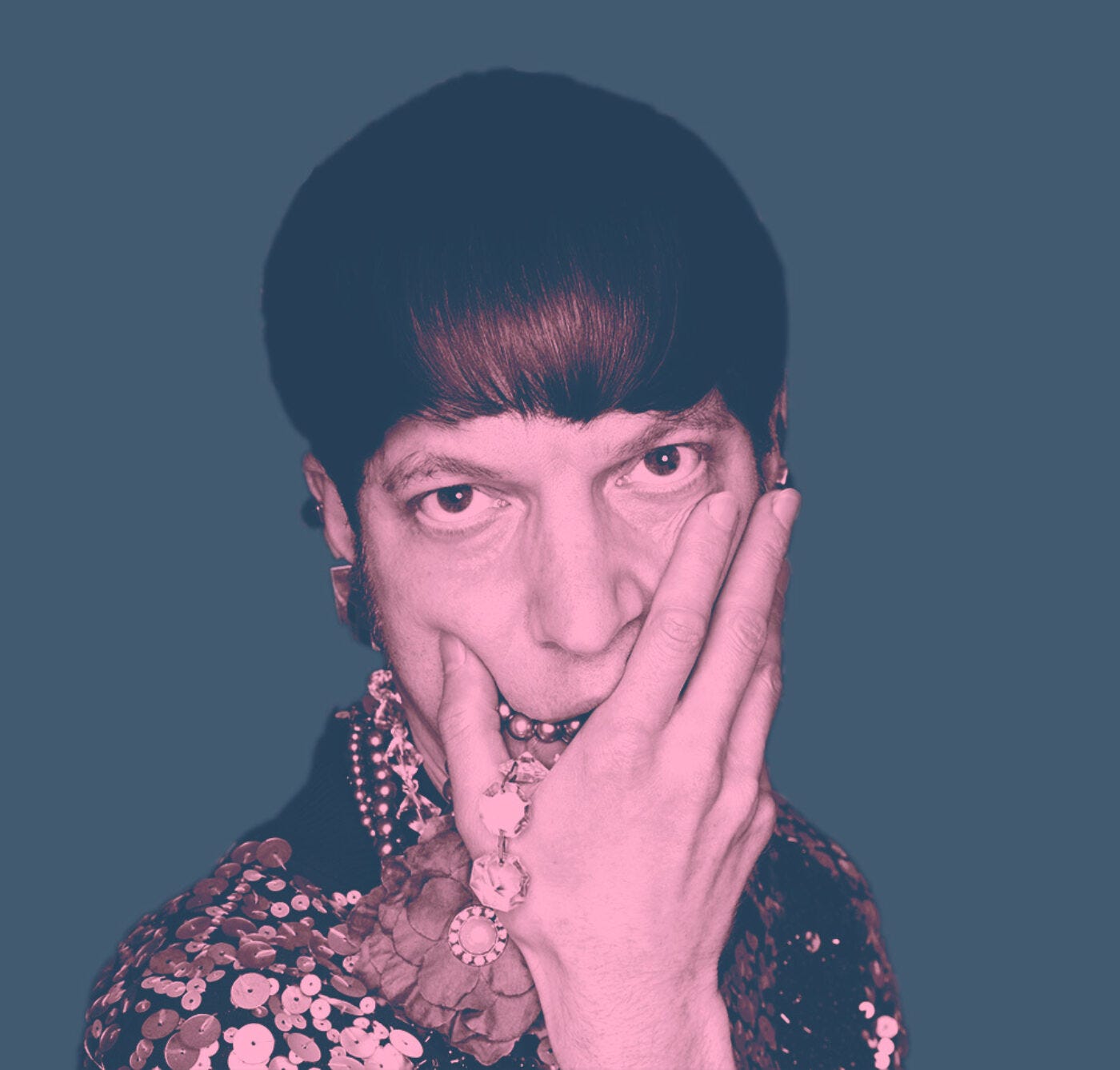
How much of this is literally Mattilda Bernstein Sycamore’s story? Who knows? Does it matter? I loved Sarah Schulman’s description of Terry Dactyl as “a book about consciousness, art, and ‘getting ready’ to be part of a world that will never be ready for you.” And I learned a lot about MBS and about writing from her December 2020 interview with essayist Amy Gail in BOMB magazine:
AG: This is sort of a hard turn, but would you call The Freezer Door a memoir?
MBS: I would call it a lyric essay. The reason is because it’s broken. It circles around the gaps, and I’m in search of something I may never find. Also, I think a lyric essay can incorporate poetry, memoir, fiction, criticism, and everything in between and beyond, and that’s what I’m after—to expand the possibilities of feeling.
AG: When you’re writing something that’s more straight fiction, do you approach it differently?
MBS: Well, I don’t know if I write “straight fiction.” (laughter) I believe more in the porousness of writing than in any kind of genre. I want things to break form, change form, and change us in the process. I’m not breaking form just to break form, but I’m breaking form to work toward an emotional opening. And a lot of that means showing the emotions closing off. I experiment because I want to get somewhere that I’ve never been.
A lot of writers—including writers I love—find something that works for them and do it over and over again. Now, I know I’m always going to be obsessed with the same themes, and I’m sure there are some people who are like, Oh my God, why is Mattilda writing about trauma again? Or about desire? Or about public sex? Or about sex work? Or about intimacy? Or about, you know, hating gay marriage? Or about chronic pain? Or about dancing? Or about drugs? Or about, you know, going on walks? Or about trying to exist in a city that no longer allows us to dream? Or about gentrification? Or about longing, or loss? Or about queerness? Or about failure? Or the hypocrisy of the liberal imagination? Or everything that lets us down? I’m not worried about writing the same themes, but I don’t want to write in the same way all the time. That’s what I like about language, about playing with language. I’m playing with repetition. I’m playing with sound and the texture of language and what meaning you can create from sensation and from experience and from cadence and from emphasis. Because meaning is not only what we impose or what we imagine. Meaning is what happens anyway.
What fascinates me is how MBS can cover this territory repeatedly without drying up or getting boring. That passage accurately catalogues her preoccupations as a writer. You’ll know by your response to that summary if her work will speak to you the way it does to me.
If you are enjoying these posts, please consider becoming a subscriber. All eyes are welcome, and I especially appreciate paid subscriptions. They don’t cost much — $5/month, $50/year — but they encourage me to continue sharing words and images that are meaningful to me. If it helps, think of a paid subscription as a tip jar: not mandatory but a show of appreciation.