
Reading List: THE LOST CONVERSATION

I’m practically the ideal reader for The Lost Conversation, Sara Farrington’s collection of interviews with 26 artists from the downtown avant-garde performance world. I’ve seen almost all of all these artists’ work, I’ve met and/or interviewed almost all of them, and I’m a sucker for Q&A interviews. Unlike journalists like me, whose interviews tend to spring from a particular project they’re promoting, Farrington conducted all of her interviews specifically for the book, mostly during the pandemic, leaping off from a specific burning existential inquiry. After a disastrous workshop of a new play, she felt lost, hopeless, and depressed, and she turned to veteran theater artists she admired to find out what has kept them going.
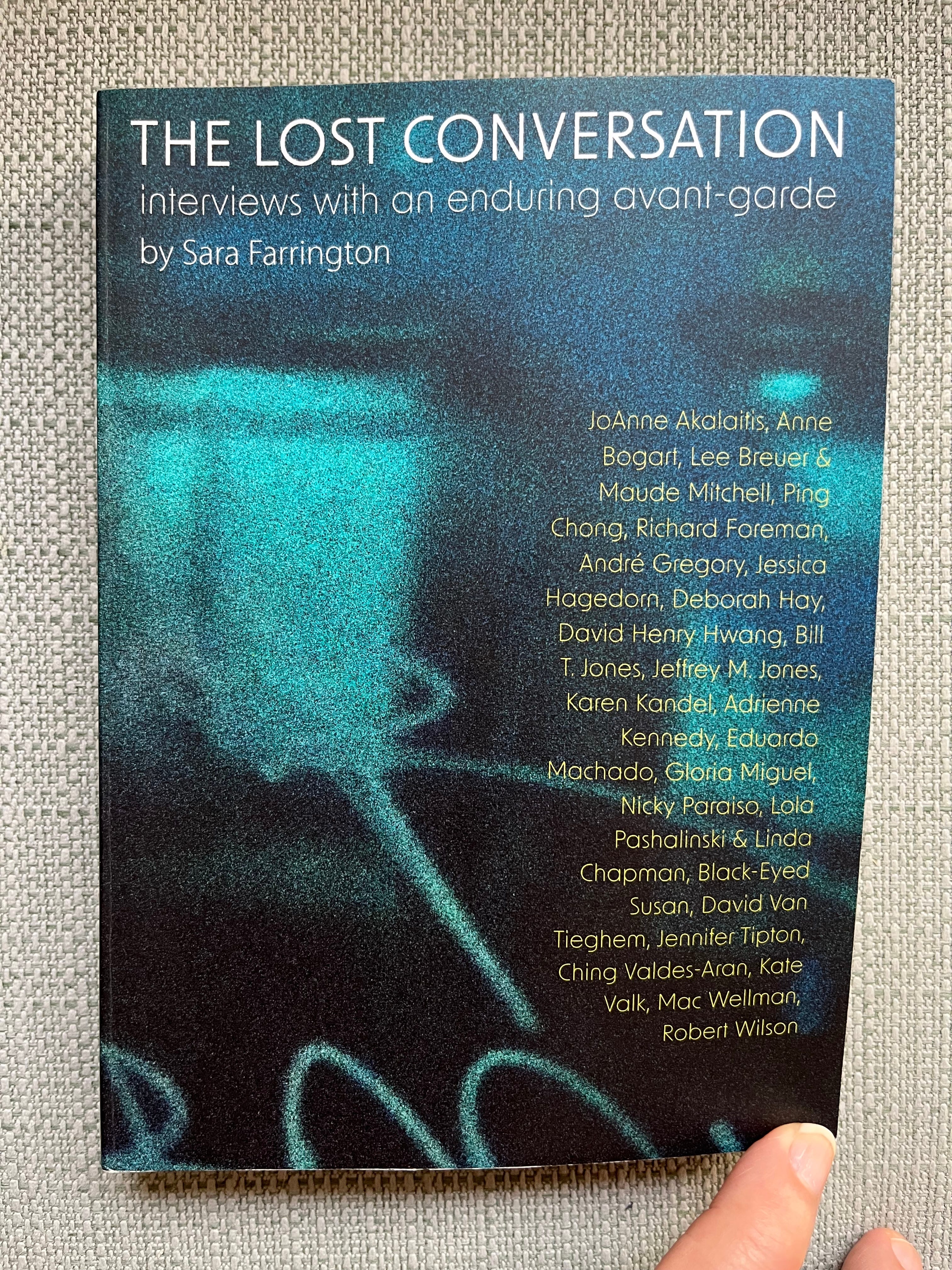
In contrast to the dumb things journalists often ask artists, Farrington approached her subjects as a colleague and asked them specific, pertinent, practical questions. “How did these artists raise the production money? How did they pay their collaborators? How did they pay their rent? How did they balance a day job with rehearsals? How did they juggle parenting with rehearsals? How did they manage so many strong artistic personalities in the room? How did they deal with failure, and success? Did they ever feel pressure to create something ‘normal’ as opposed to something avant-garde? How did they deal with ‘no’? How did they react when racism and sexism reared their ugly heads in rehearsal, performance, and criticism? Did they ever want to quit? How did they stay committed?”
These are excellent questions, and they generated honest and detailed responses that revealed fascinating responses from almost everyone, including people I’ve read a million interviews with. Farrington managed to include almost all the heavyweight directors you can think of in downtown theater (Foreman, Wilson, Akalaitis, Breuer, etc.) as well as a consistently interesting assortment of playwrights and performers, with a few less-than-obvious good choices such as dancer-choreographer Deborah Hay, composer-musician David Van Tieghem, and Gloria Miguel, co-founder of Spiderwoman Theater.
Here are some of the cool things I learned from the book, which was beautifully published in 2022 by Karen Kremer at 53rd Street Press:
The great actor Karen Kandel, now co-artistic director of Mabou Mines, mentions studying with Fred Curshack, a wonderful creator of strange puppet theater whose name I haven’t heard in years. After years of working with Liz Swados, she took a break from performing. She and her husband Paul (also an actor) moved to Katonah, where she worked in a hardware store, hanging wallpaper. Martin Moran encouraged her to audition for Anne Bogart’s adaptation of Gertrude Stein’s The Making of Americans. She gave (by her description) a horrible audition. “I’m shaking, I probably cried, I’m always crying. And afterwards, [Bogart] got up from behind the table, took my hand, shook it and said: Karen, welcome back to the theater.” Thank God Anne Bogart is such a mensch. Imagine if we’d never gotten to see Kandel’s one-person performance of Peter and Wendy under Lee Breuer’s direction!
I always love when interviews get into the nitty-gritty of money. Farrington shares with almost all of her subjects Richard Foreman’s observation, “Most of the people that I knew that were making experimental art in those days came from families who had money.” (The one exception he notes is Lee Breuer.) David Henry Hwang’s parents bought him an apartment in 1981, when he was just out of Yale. It cost $68K and only required a 10% down payment ($7000). Those were the days!
I never get tired of reading interviews with Joanne Akalaitis. She’s always so honest and down-to-earth. During the pandemic, she said, “I don’t spend the day in my pajamas. I put on mascara.” And “I kind of like that I can tune into some Zoom theater thing and give them my ten or twenty dollars. And if I don’t like it I can turn it off. And I haven’t taken the subway to BAM and spent a lot of money to see a German Shakespeare production by a sexist male director. I don’t miss going to Times Square.” She recalls actor Joan MacIntosh once telling her that no other director had ever asked her, as a mother, when the best time to rehearse for her was, considering her kid.
“I had a women’s theater salon for three years in my house,” Akalaitis says. “It was once a month on Sunday at 5 o’clock, open to theatermakers. The group was anywhere from 10 to 30 people, ages 25 to 83. All women, no men. And we’d read something and talk about it, anything from Joan Rivers to Caryl Churchill to Strindberg. We’d have a lot of food and we’d sit down and talk. And there was no leader. There was no one to raise your hand to. Several women said to me, Men could never do this. We could never get twenty men in the room to eat like maniacs, talk about something, and then clean up. Men couldn’t do it.” How I wish someone would write something about what it was like to participate in that salon!
Jennifer Tipton went to Cornell to be a physicist, like her mother. She discovered that she loved downtown theater “through Ron Vawter. What a wonderful actor he was. He called me up and said, I think the Wooster Group is ready for you! (Laughs) And I’ve been working with them ever since…With the Wooster Group, it’s when I have time off. Even if it’s just one week, I reach out and ask what their schedule is. When I’m free, I’m like, What’s Wooster doing?”
Mac Wellman, who has inspired a generation of artists as both playwright and teacher, gives props to visionary producer Greta Gunderson, an undersung producer whose BACA Downtown produced first plays by Suzan-Lori Parks, Tony Kushner, and Erik Ehn, among others.
Farrington asks Ping Chong, “Why do you think there was such an explosion of innovative avant-garde work during that time specifically [the 1970s]? Was it as simple as cheaper rents?” He says, “That and hallucinogens. (Laughs) It’s true! Nobody talks about hallucinogens in the art world, but it’s really important to talk about it because it opened everybody up.” I wish Farrington had asked everybody about psychedelics!
She continues pondering these essential questions in her Substack, Theater Is Hard — check it out here.
If you are enjoying these posts, please consider becoming a subscriber. All eyes are welcome, and I especially appreciate paid subscriptions. They don’t cost much — $5/month, $50/year — but they encourage me to continue sharing words and images that are meaningful to me. If it helps, think of a paid subscription as a tip jar: not mandatory but a show of appreciation.
Thank you! I’ve seen work by many in the book but not all. I read this book when it came out and thought the interviews so great. And yes, the money part was unusually honest. I didn’t know Sara Farmington had a Substack, so thanks for pointing that out.
Thanks, Don. I need to read this.